Wednesday, November 29, 2006

3 Questions to Slifkin

In a recent article in the Jerusalem Post, R' Nosson Slifkin declares ID to be against Judaism:

But there are also significant theological problems [with ID]. If God's existence is being demonstrated in phenomena for which there is argued to be no scientific explanation, then what about all those phenomena for which there is a scientific explanation?
...and a few papagraphs later:

So where does that leave the rest of the universe? What about all those structures that do not, even by the admission of the ID camp, present irreducible complexity? The unstated implication of their position is that these things do not attest to a Creator. Don't have a grasp of cellular biology? Sorry, you won't be able to perceive that the universe was created by God.

Either God is everywhere or He is nowhere. But He is certainly not limiting His appearance in the universe to the bacterial flagellum and the blood-clotting system.

When I wrote about this issue a while ago*, what Slifkin calls a rejection of ID I called "ID - natural process?" I explained such a view:
"They basically feel G-d could have done it with just one ma’amar so surely he did. Why ‘bother’ with 10 ma’amoros?" Slifkin is now also claiming that the ten ma'amaros would mean G-d's design can't be observed in anything else. While I understand why he wouldn't like a theory that sounds like "G-d of the gaps", I have some questions for him:
  1. How is Slifkin so sure G-d wouldn't want to show directly His continued involvment in the world? How does that minimize evidence of G-d? What does slifkin believe about miracles such as yetzias mitzrayim?
  2. How does Slifkin explain the Mishna and pesukim about ma'amaros that say G-d created the universe with many steps ?
  3. Darwinism's primary purpose is to explain how the great complexity of the universe could have happened randomly, taking away the need to believe in a G-d. Eventually, it will have its place in history with theories such as Freudinism and Marxism. Why does Slifkin have so much faith in it?
Maybe I'll post his response.


*(See "Ma'amaros and Miracles". Of some relevence is "G-d and Design".)


Tuesday, November 14, 2006

The Internet

Due to the various problems the internet pose, the haredi community has called for a full ban on its use. This approach will not work. We're already in the internet 2.0 age and the internet is becoming more and more essential. Look at the growth of the internet over the last ten years to get an idea of how big it will be in another ten years. Eventually everything will be on the internet and it will be unavoidable.
Even now, its a necessary or helpful for almost anything. You can get instant information on any topic, you can buy or sell anything, communicate with people, get torah shiurim, etc., etc. The internet is as ubiquitous as the automobile.
It's also like a car in that its dangerous, although in a spiritual way. But no one is calling for cars to be banned just because they can crash. Just like you buckle your seatbelt and drive carefully, you can do the same thing with the internet; in fact you can take stronger precautions. Depending on how much protection you want, you can put use adblock, image blockers, parental controls, web-tracking, or whitelisting. This is the correct way to deal with the problems the internet pose.
Some people think the internet is less like a car and more like the Television. The haredim have gotten along fine without TV. But the comparasion is flawed. Unlike the internet, the TV has barely any useful purpose besides killing time. In addition, a person can use the internet carefully and never see anything bad, while the television is filled with bad shows and ads.
The internet can best be compared to the printing press - it allows the proliferation of information, both good and bad, in a way never thought possible before. Just imagine how much less torah we would have if the printing press had been banned.

Friday, September 1, 2006

Direction of Prayer


Here are pictures from Google Earth with lines emanating from Israel. The purple line in the picture below shows the approximate direction people pray to. It would end up in Uganda, but the intentions bend it. The Bluish line is the actual direction to Israel.

Update: A more accurate image was added. The yellow line goes due east, towards the Congo. The white line is the direction to Jerusalem.

Wednesday, August 30, 2006

Back to School

I'm going to be going to yeshiva so I'm not sure if this blog will continue having new posts. I originally said I would blog about: Science, Miracles, Metaphors, Lakewood, Black Hats, Israel, Metzitzah and Jumping Elephants. I already wrote about the ones crossed out and about many more topics. Other topics that I would have wanted to mention: Proving Judaism, Anti-Science, Hilchos Haircuts, Hilchos Music, The Internet, and much more. Maybe I’ll figure out a way to continue blogging.

P.S.

I changed the format so all 25 posts show on the Nebach! page itself so you don't need to look at the archives.

Monday, August 21, 2006

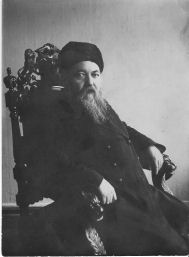
Gedolim Pictures I -- R' Menachem of Vilna


______The reverse of the picture says:

Harav Menachem Krakowski
b. in Volkovitch 5630 (1870 CE)
d. in Vilna 5689 (1930)
he was an av beis din in the following kehillos:
Tinkavitch, Haslavitch, Navordok.
Magid Mesharim and Moreh Tzedek in Vilna.
He learned in Vilna and he served the Geonim Meran Naftoli Tzvi Yehudah Berlin and Rabbeinu Chayim HaLevi Soloveitchik. Son-in-law of Rabbi Eliyahu Feinstein Av Beis Din of Pruzaner.
Author of the Avodas HaMelech and the Arzei HaLevanon (published after his death).

signed,
[his Nephew Rav] Yosef Dov HaLevi Soloveitchik (Boston)

Saturday, July 1, 2006

Have a Good Summer

I will be iy'h away for practically the rest of the summer, so it is unlikely there will be any posts here. I also won't be able to revise the post below this one.

Friday, June 30, 2006

Ma'amoros and Miracles

“With ten ma’amoros (utterances) the world was created. And what does this teach us? Couldn’t the world have been created with one ma’amar? Rather to take retribution from the reshaim who destroy the world that was created with ten ma’amoros and to give reward to the tzadikim who sustain the world that was created with ten ma’amoros”

-- Avos 5:1

What were the ten ma’amoros? They were divine ordinances, but were they just a natural process of creation or were they actual unnatural interventions that created the world? A parallel question can be asked about Intelligent Design. The universe clearly shows evidence of design but can the process of creation still be explained naturally? Science has explained many things that before were simply attributed to G-d, so maybe it can explain the process of creation as well. People used to explain why leaves change color and why it rains by saying G-d causes it, it’s like a miracle, but now we know that the system can be explained with natural laws, the system G-d created. Perhaps creation is similar. Instead of just saying that G-d created all the plants and animals, maybe we can also explain the natural process that happened. In other words, is Intelligent Design just a logical conclusion that can be seen from looking at evolution or is it a necessary explanation for what evolution can’t explain naturally?

Most scientists claim they can explain the existence of all living things just with Darwinian Evolution, but it doesn’t actually work. Small changes cannot explain the great differences between different categories of animals, and the fossil record goes against it. Another evolutionary theory, Punctuated Equilibrium, says the changes happened very quickly after long periods of equilibrium. This theory doesn’t really explain why nature should work like that, but it does fit the fossil record better. Intelligent Design can explain why there would be major changes and how such an organized system would be the end-result.
From the Torah, it seems that there were separate events that weren’t natural. Although only the beginning was creation ex nihilo, each ma’amar seems to be more than just the flow of nature. Some people don’t like this idea and feel it must all have been natural, B’raishis is just hashkafic. They basically feel that G-d could have created the world with just one ma’amar so surely He did. Why ‘bother’ with 10 ma’amoros? Of course, this is the issue dealt with by the Mishnah. The Mishnah explains that the 10 ma’amaros bring reward and punishment into the world; the world is more valuable because of the ma’amoros that made it. To say the only ‘miraculous’ act was creation is almost like Deism, it sounds like saying G-d has no more part in the world. But G-d does, and the ten ma’amoros show that our actions make a difference. When someone sins, he is destroying a world that was created with much ‘effort’ and something the Creator is still actively involved in.

A similar issue arises with nissim – some claim miracles don’t break any laws of nature, they’re just unlikely events that still show G-d is in charge. The sea split naturally because of the wind and just at the time the Jews needed to get across. They feel G-d doesn’t need to break the laws of nature, He’s able to run the world within the system of nature. Also, the greatest wonder is nature itself, so miracles aren’t necessary.
This view is somewhat meaningless nowadays because quantum physics basically says anything could happen, if the smallest particles move in unlikely enough ways. The sea can split naturally even without wind; everything is just probabilities. Anyway, it’s incorrect to say the laws of nature are never broken. G-d intervenes in nature not because He needs to, but to show that He exists, is involved in the world, and we matter to Him. The same thing can be figured out logically, but won’t be strong enough to withstand pagan influences. Avraham was able to convince many people to believe in One God, but his followers' descendants didn’t remain monotheists. Even the Jews themselves became idol worshipers during the exile in Egypt. G-d revealed Himself with miracles so Judaism could better overcome false ideologies.
Some still feel the laws of nature were never broken because it seems quite strange, and doesn’t appear to happen nowadays. But those days were different. There appeared to be all sorts of different forces in the world, and paganism was the dominant ideology. Even a miracle didn’t remove bechirah completely, there was no known system of nature yet. When there was still idolatry, there could still be prophecy and miracles could also be more frequent. Nowadays, the miracles are more hidden than krias yam suf (though still show that history is being guided).
Some feel the unnatural is greater than nature; all of creation was completely miraculous, nature itself isn’t worth studying except for the parts we don’t understand which are the most wondrous. But this is also incorrect. The greatest wonder is not miracles, but nature itself. And the most amazing things in nature are systems we understand the most complexity of. Although it may be amazing how birds can get south, even more amazing is the complexity of photosynthesis. The greatest niflaos ha’boreh are not seen by looking at the gaps in our knowledge. The Mishnah asked a very strong question, why the interventions were necessary at all. We would think it should just all be nature. But ma'amoros and miracles have a purpose. G-d is still involved in the world and the choices we make matter.